.svg)
Table of Contents
MCC stands for Mobile Country Code. It is a two- or three-digit number used to identify the country to which a phone number belongs.
The country code is entered after the international dialing code or prefix. Each country has its own unique code.
This system was established by the International Telecommunication Union in its Land Mobile Numbering Plan. The MCC is also used to establish the IMSI (International Mobile Subscriber Identity) and the LAI (Location Area Identity). Both are used to uniquely identify a mobile device and its location.
In addition, these two identifiers include the Public Land Mobile Network, which is used to uniquely identify a wireless network operator.
What are the most frequently used MCCs for making calls from France?
United States country code: +1
Canada country code: +1
United Kingdom country code: +44
Belgium country code: +32
Italy country code: +39
Germany country code: +49
Tunisia country code: +216 and +217
Morocco country code: +212
Ivory Coast country code: +225
Why is it important to know the MCC?
Calling or texting abroad is a bit more complicated than communicating within France. You need to take a number of factors into account, including data rates, international dialing codes, and country codes.
The international dialing code is necessary to help the phone network understand where you want your call or message to be routed. With so many countries in the world, it is essential to have a way to ensure that every communication is routed to the right place.
How can your business use MCCs?
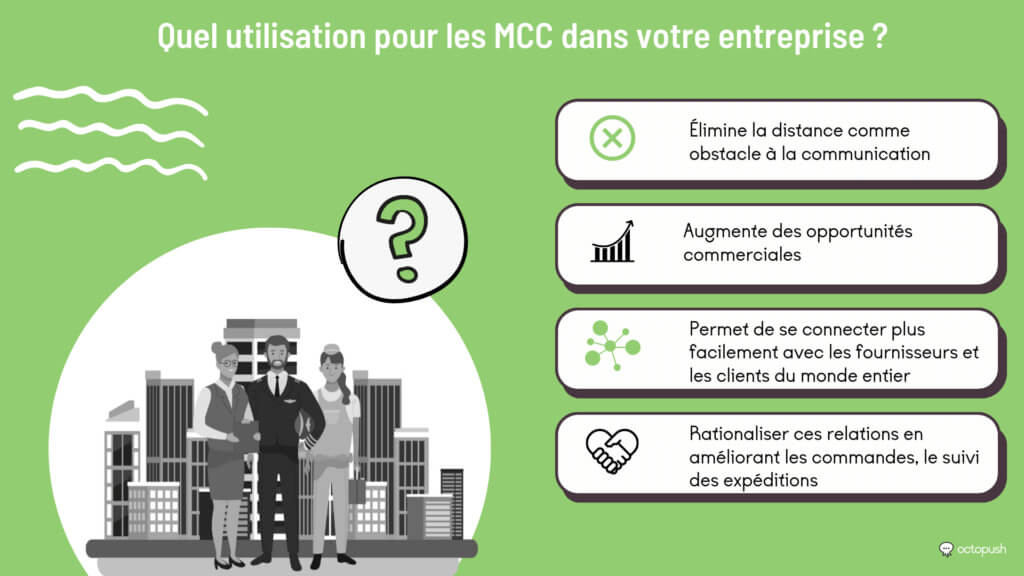
The rise of instant messaging has led to an increase in international communication. Electronic communication has effectively eliminated distance as a barrier. A global society means increased business opportunities.
Many companies hire employees who are located abroad. Technology makes it easier to connect with suppliers and customers around the world and to streamline these relationships by improving ordering, shipment tracking, and more.
Thanks to this type of communication technology, many companies are able to take advantage of opportunities in different countries or cities, thereby improving economic prospects on a global scale.
How can you achieve successful cross-cultural communication for your business?
When managing teams, a key challenge for effective intercultural communication is clarifying expectations and what has been put in place.
This is particularly important when you are managing teams from all over the world. Be aware of different communication styles—some may be more direct than others, or may only provide feedback at certain stages.
Another important point to cover is having a clear understanding of time zones and working hours. You wouldn't want to send a message or try to reach a potential client while it is nighttime for them.
Different from MNP Lookup, knowing the MCC allows you to identify which country you are doing business with, and also makes it possible to look for solutions that facilitate communication with the country you are interested in reaching.
Perform an HLR lookup on your contact list to sort by MCC
You can obtain the MCC of a mobile phone number by performing an HLR lookup.
When you perform an HLR lookup query, the result provides you with valuable information such as the subscriber's IMSI, the subscriber status (success/failure), and the MCC and MNC of the roaming network. The MCC-MNC tuple is stored in the first five or six digits of the IMSI (International Mobile Subscriber Identity).
Example of results from an HLR lookup
PLMN: 20801
Country: France
MCC: 33
Network: Orange (Orange S.A.)
Time zone: Europe/Paris
Benefits of HLR lookup
Bulk SMS service providers receive location information following the lookup (visited country and visited network). Sending SMS to a mobile subscriber can be done via a specific route or a local connection provider, which helps reduce routing costs.
Information regarding mobile number portability can be obtained from the lookup results. HLR Lookup provides real-time information for roaming subscribers, allowing service users to plan announcements based on roaming locations.
HLR lookup returns the current location of a mobile user. This creates opportunities for content marketing to reach people who are in the vicinity of the company's premises.

Content providers use location information to advertise their products effectively.