.svg)
Table of Contents
Logging into most corporate networks, e-commerce sites, and virtual communities is extremely easy. All it takes is a username and a static password to gain access to personal and sensitive data.
This is why implementing a two-factor authentication (2FA) system has become essential to enhance the security of personal customer data, employee information, and sensitive records.
Sending a voice message via SMS: 2FA use cases
One-time passwords (OTP) are a key part of the global two-factor authentication market. As revealed by a study from Market Research Future, this market is set to reach $8.9 billion by 2024. The primary industries involved include finance, insurance, public services, healthcare, and gaming.
An OTP is a six-digit numeric code sent to validate a transaction in real time. It is delivered either via SMS or voice message to the mobile phone number provided by your customer.
Every company has different needs when it comes to protecting user accounts.
Sending a voice message via SMS in finance
OTP via voice message can become mandatory for authorizing transactions, such as bill payments, registering DirectDebit and Direct Pay instructions, transferring funds to another account, or updating personal account information.
Insurance
Much like the banking sector, insurance companies can implement OTPs via voice message to verify customer accounts during transactions. For example, the Indian government has recently amended insurance laws to allow the replacement of physical signatures on application forms with OTP verification received on the customer's mobile phone.
Public services
Government agencies face a unique security challenge. Security breaches put the personal and sensitive data of millions at risk. Public service officials access these systems on a daily basis, making the risk particularly high.
Verifying employee accounts is necessary, and using multiple factors is an ideal measure. An OTP sent via voice message provides an extra layer of security by restricting access to those who possess both factors: in this case, their login credentials and the code received via phone call.
Healthcare services
Healthcare services require robust IT security because they handle confidential data, such as patient health records. Ransomware attacks are on the rise because cybercriminals believe hospitals are more likely to pay ransom demands. According to HealthCare IT Security, the healthcare sector accounts for 79% of all data breaches.
Two-factor authentication via voice message can curb attacks on healthcare organizations, as a cybercriminal must possess both the password and the code sent to the user's phone to access their account.
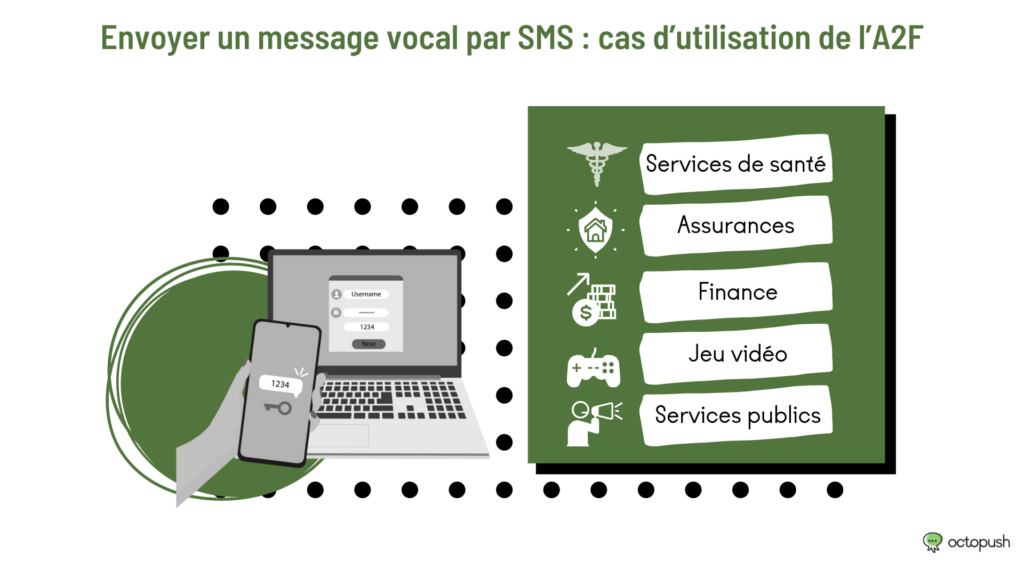
The video game industry
The video game industry is vulnerable to cyberattacks. The biggest security risk concerns the players themselves, who reuse their passwords across multiple sites without taking additional security measures. Consequently, credentials stolen from video games are used to access other accounts that share the same login information.
Implementing a second layer of security via a voice message that transmits an OTP key can be a crucial solution for protecting player accounts, which are generally linked to a credit card or other payment methods.
Why send a voice message via SMS to protect customer accounts?
Unlike SMS, voice messages have priority on telephone networks, meaning the recipient will receive the phone call containing their OTP without delay and without the risk of ending up in spam, as could happen with a traditional SMS.
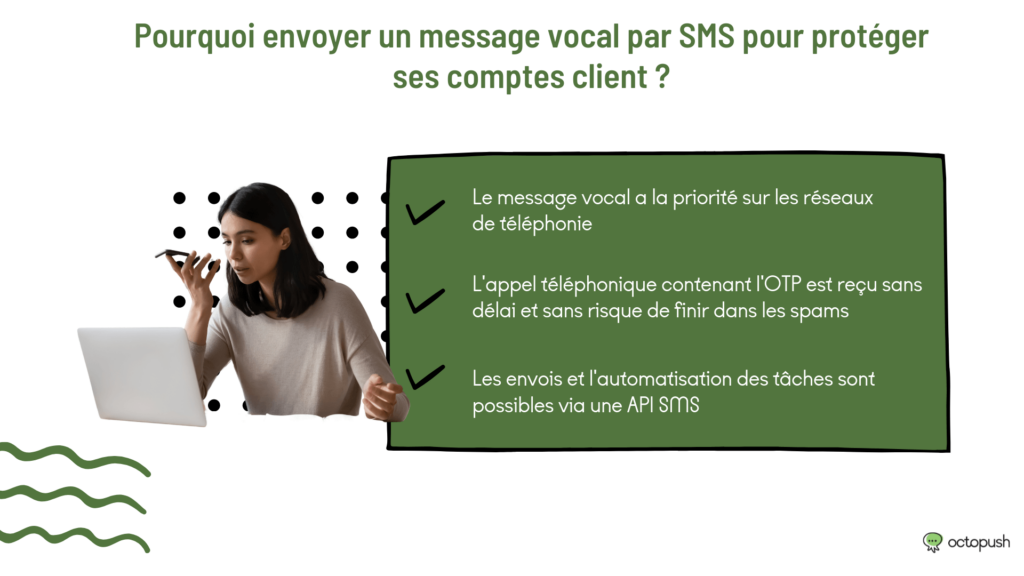
A voice message takes the form of a call, but the OTP message is generated textually. This allows you to schedule sends and automate tasks using an SMS API service that supports voice message creation.