.svg)
Table of Contents
Growing your client list seems like the ideal scenario for any company. But have you ever wondered how many of those numbers are still valid? You might be trying to reach customers who have changed their phone numbers, rendering your marketing and customer service efforts useless. Furthermore, this results in expenses that could easily be avoided by using an HLR lookup service.

What is HLR Lookup?
HLR stands for Home Location Register.
Running an HLR lookup helps determine if your contacts' phone numbers are up to date. The service then removes outdated client records.
By keeping a clean customer database, you save on the cost of sending messages to invalid phone numbers, as it eliminates the time spent sending messages to inactive numbers, thereby reducing the likelihood of error messages.
Thanks to HLR, you save time with targeted mobile marketing campaigns for active client records.
Data analysis and contact cleaning take place in real time.
What is the function of HLR equipment?
Mobile phones and their corresponding SIM cards are constantly on the move. The HLR is used to identify their last known location.
This information is updated every time the device moves to a new location.
The HLR also facilitates SMS services by identifying which Mobile Switching Center (MSC) the recipient is using at the time of sending. If the recipient is reported as unavailable by the receiving MSC, a message waiting indicator is sent to the HLR. The message is then delivered as soon as the recipient is located on any MSC.
What information does the HLR provide?
When you submit a verification request for your database, the SGS partner provides a detailed status of the HLR request in real time.
The HLR database contains various information about all mobile phone number holders on the mobile network (such as the Mobile Network Code, or MNC). The idea behind an HLR lookup is to verify whether these numbers are still on the specified network or if the holder has switched to another network, among other details. Once this analysis of phone records is complete, inactive files are removed.
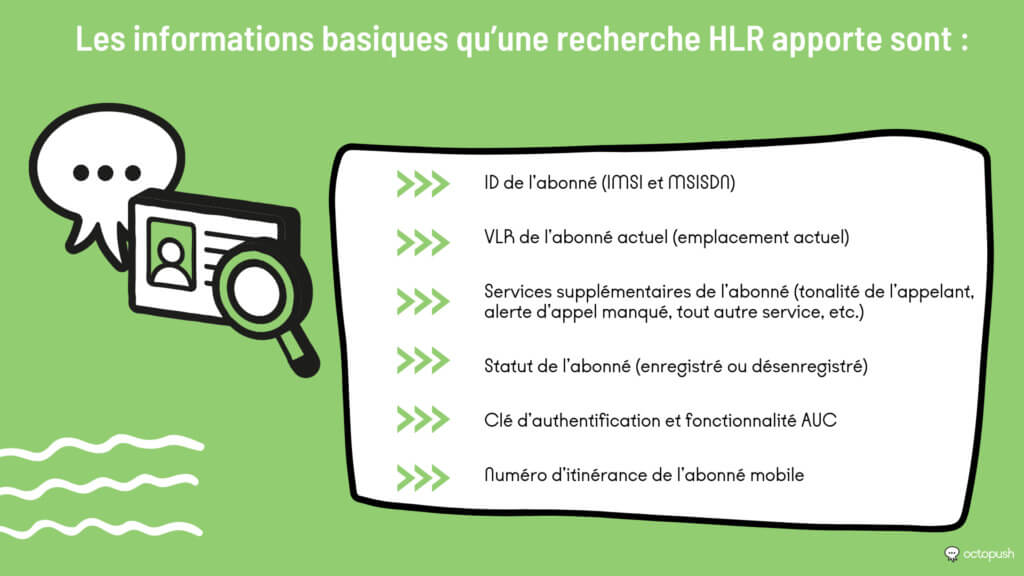
The basic information provided by an HLR lookup includes:
- Subscriber ID (IMSI and MSISDN)
- Current subscriber VLR (current location)
- Subscriber supplementary services (caller ringback tone, missed call alert, any other service, etc.)
- Subscriber status (registered or deregistered)
- Authentication key and AUC functionality
- Mobile Station Roaming Number
Also discover the MNP Lookup method.
What are the differences between HLR and VLR?
When looking for databases that store subscriber-related information in a GSM architecture, you will likely come across the term VLR as well.
Much like the HLR, the VLR (Visitor Location Register) saves information about subscribers on a telephone network; the difference is that the VLR contains more dynamic information regarding subscribers roaming within the smaller VLR area.
Both the HLR and VLR store information related to subscribers registered on the network, in accordance with GSM architecture.
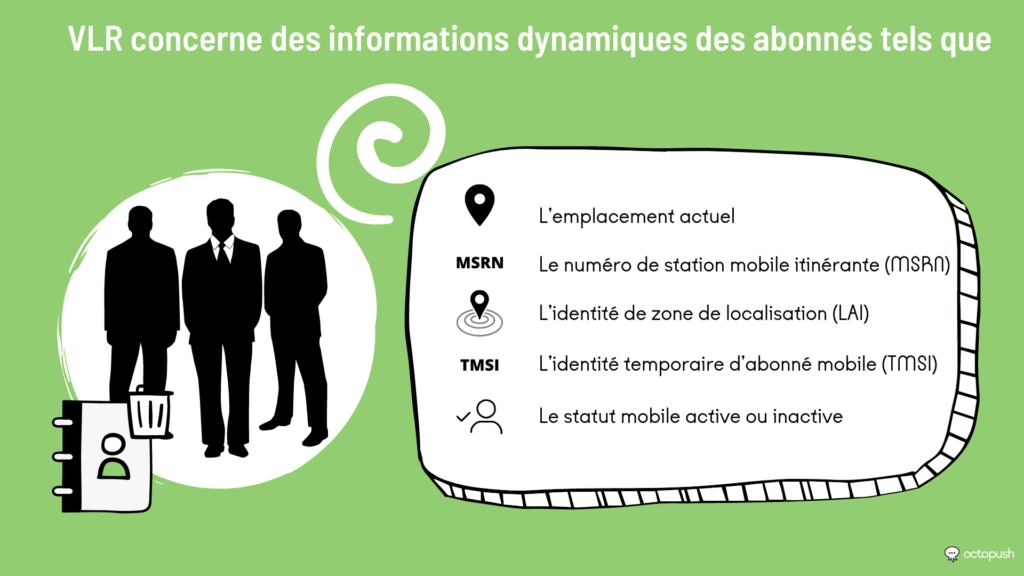
The HLR is a fixed reference point for a given mobile station, while its VLR can change depending on mobility and network design. The VLR concerns dynamic subscriber information such as:
- Current location
- Mobile status (active or inactive)
- Location Area Identity (LAI)
- Temporary Mobile Subscriber Identity (TMSI)
- Mobile Station Roaming Number (MSRN)
- The status of the mobile phone, whether it is busy, idle, or not responding
In general, the HLR contains information on all subscribers in a network, while the VLR is temporary. When you request a lookup from the HLR, the database will also communicate with the VLR.
The VLR function call eliminates the need for excessive references to the HLR database.
In the world of telecommunications, you can also find other very interesting information such as the MCC, also known as the mobile country code.
Why avoid a free HLR service?
While browsing the internet, you will frequently find services that promise to perform an HLR lookup for free. However, you should know that these types of services are usually either faulty or overwhelmed by advertisements.
Furthermore, these services limit the number of requests you can make to the HLR, or they impose a cap on the number of contacts you can verify before pushing you toward a paid solution.
Octopush offers an affordable HLR lookup service, allowing you to verify all or part of your mailing list in real time.