.svg)
Table of Contents
Today, network security has become a top priority for businesses of all sizes. According to the 2021 Euler Hermes Barometer, identity theft accounts for 38% of cyberattacks against small and medium-sized businesses. In fact, two out of three companies experience this type of fraud every year.
This is why it is essential to incorporate an authentication system using a digital verification code for accounts into your IT security strategy. In this article, we will outline the benefits of using such a system via SMS.
What is identity theft?
This type of fraud occurs when someone gains access to your personal data, your company's confidential information, or that of your employees, and uses it to make purchases, open bank accounts, receive medical care, or rent property—in short, performing various actions in your name without your authorization.
How does identity theft happen?
Identity thieves can access your personal information in several ways. Here are the most common examples.
Phishing
Cybercriminals send fraudulent emails that appear legitimate. By clicking on the links they contain, the victim accidentally downloads malicious software (malware).
This software can compromise user privacy, extract personal information from the victim's computer, and send it to the cybercriminals.
Data breaches
A data breach puts the personal information and privacy of millions of people at risk. For example, the Equifax data breach exposed the personal information of no fewer than 147 million users.
Verification number: what methods can protect you from identity theft?
It may seem obvious, but the most crucial measure to implement when securing your company's data is establishing strong internal controls.
It is important to integrate best practices regarding employee passwords and to limit their access to certain documents, such as client lists or accounting files.
In addition to changing passwords at least every three months, it is essential to use random password generators, perform external password backups, and implement two-factor authentication to improve your data security. For this type of verification, SMS is the ideal solution.
Verification number: why use SMS?
Most applications and software use email to verify user identity. However, according to a survey by NDNM, cybercriminals target email in 91% of cases.
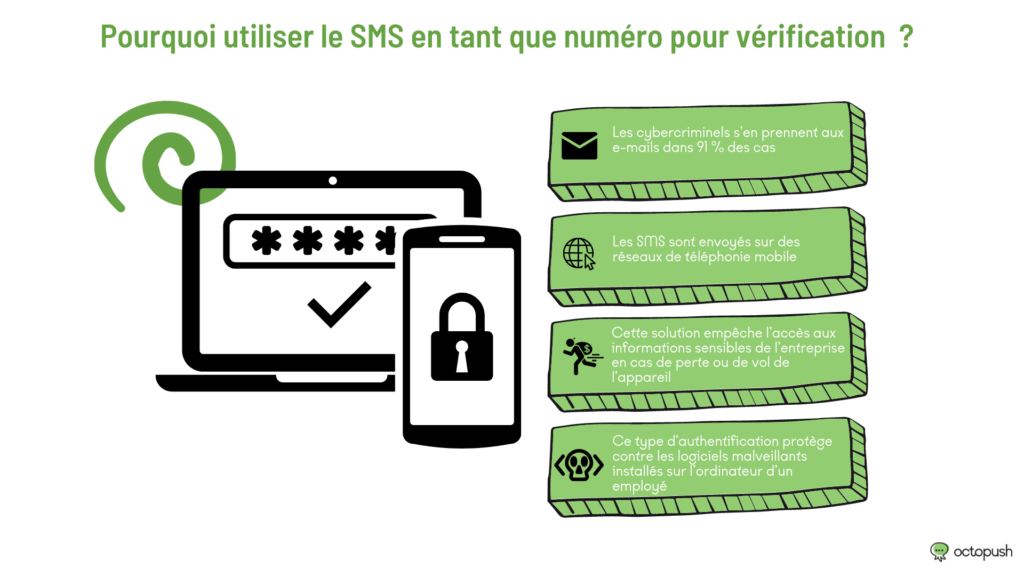
SMS messages are sent over mobile networks, meaning that for identity theft to succeed, cybercriminals would need access to both the user's computer and mobile phone simultaneously.
Remote work and the "bring your own device" trend pose additional risks for businesses. Devices must be password-protected to prevent access to sensitive company information in the event of loss or theft.
Implementing a two-step authentication process is essential. If your company's network security is compromised—for example, by malware on an employee's computer—access to the network remains protected because the software cannot access the verification code sent via SMS to the employee's phone.
Your data therefore remains secure.
Verification number: a solution for mobile wallets
Mobile payment solutions carry very real security risks for both the companies offering the service and their users. Users must protect their credentials, as a fraudster can easily divert funds from legitimate transactions to another account, especially if they have access to the account.
Companies offering mobile payment systems must guarantee that their customers are using the best encryption methods—that is, solutions that require the highest possible level of authentication.
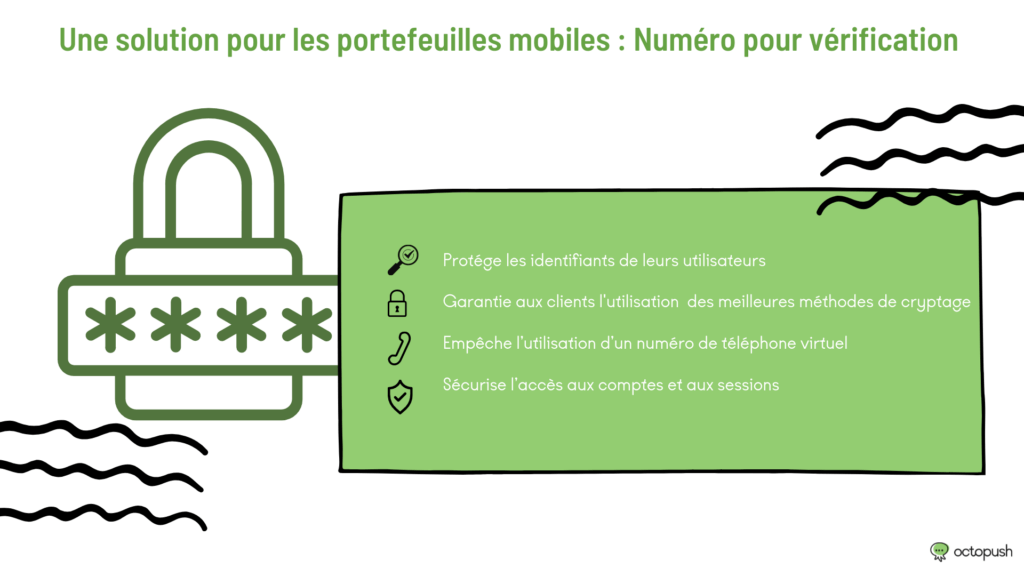
In this case, receiving an OTP key via SMS is not optional. Authentication must be mandatory to establish a link between the phone number owner and their account simply via an OTP message. Companies offering mobile payments must also prevent the use of virtual phone numbers, a practice that allows verification to be bypassed by enabling the creation and use of accounts without a fixed identity.
Ultimately, two-factor authentication is a method for securing access to accounts and sessions that every company should implement. This service sends your employees an SMS containing a code that allows them to access your company network.