.svg)
Table of Contents
The emergence of OTP codes represents a true revolution in security and authentication. The recent increase in the number of companies shifting to remote work models and the evolution of e-commerce have raised new questions regarding data and network security. Two-factor authentication, typically performed via an OTP (one-time password), remains one of the best methods for securing an account during login.
Definition of a one-time password
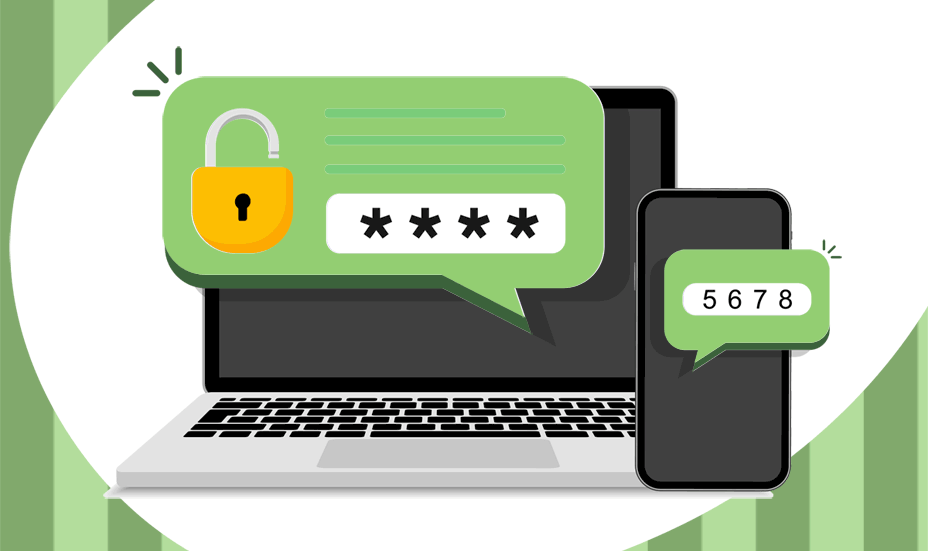
An OTP, or one-time password, is a user account login method that requires entering a code that can only be used once.
One-time passwords are numeric codes generated randomly for each authentication attempt.
They are generally programmed to be time-based (TOTP). This means they are only valid for a limited time interval, which is determined by the system generating the code.
Once entered, or once the validity period has expired, the OTP code becomes unusable.
It therefore adds an extra layer of security, as the generated password corresponds to a new set of random numbers for every authentication attempt. It is therefore impossible to guess.
OTP code: How is the key sent via SMS?
The OTP code works using a symmetric cryptography algorithm. Both parties, the sender and the receiver, share information and compare it. If the information retrieved from each party is identical, the OTP verification is successful.
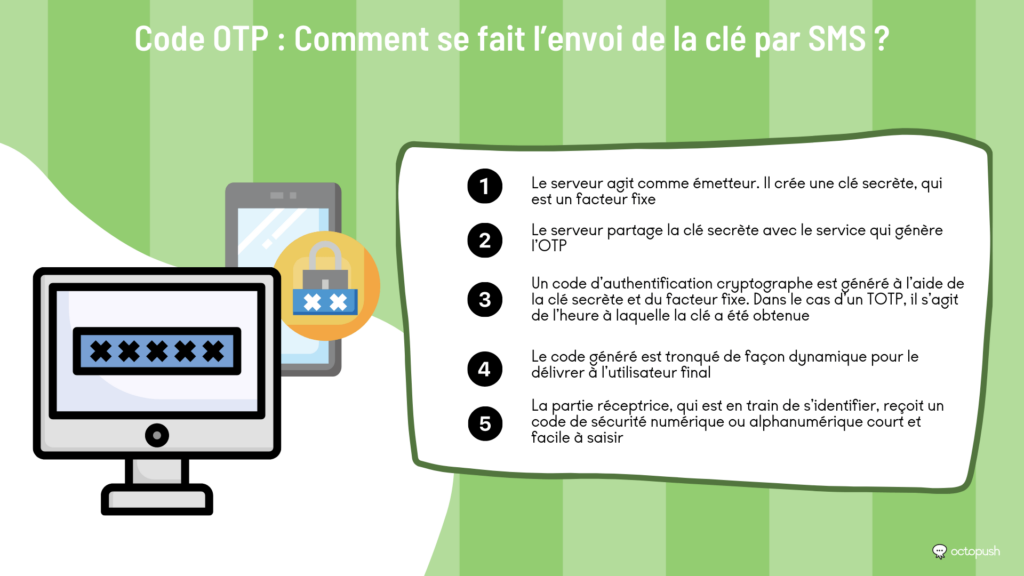
In the case of an OTP code sent via SMS, the backend process works as follows:
- The server acts as the sender. It creates a secret key, which is a fixed factor.
- The server shares the secret key with the service that generates the OTP.
- A cryptographic authentication code is generated using the secret key and the fixed factor. In the case of a TOTP, this is the time at which the key was obtained.
- The generated code is dynamically truncated to be delivered to the end user.
- The recipient, currently in the process of identifying themselves, receives a short, easy-to-enter numeric or alphanumeric security code.
On the other end, the user process unfolds as follows:
- The user enters their standard credentials, typically their email address and password.
- The system redirects them to a new window, where they are prompted to enter an OTP code.
- If the user has already registered their mobile number, they receive the code via SMS immediately. Otherwise, they must enter their phone number at that stage.
- The user receives a code via SMS and enters it into the authentication field.
- They are then granted access to their account.
OTP code: why use a security key?
Protection against online identity theft
SMS-based OTP authentication is a strong authentication method. For cybercriminals to obtain both authentication factors, they would need to compromise both the user's computer and mobile phone simultaneously.
The login process remains protected; even if a user loses their password, no one can access their account without the OTP key, which serves as the account's second layer of security.
Easy integration and deployment
Developers can integrate this system almost instantly using an API key.
No more password-related security issues
Passwords are an outdated and highly vulnerable protection method. Despite the implementation of best practices by website and application developers, end users are sometimes reluctant to use password generators or create secure passwords.
Furthermore, saving passwords in a browser opens the door to cyberattacks. Attackers exploit the browser cache to steal user identities.
These issues can be overcome by implementing two-factor authentication during account login.
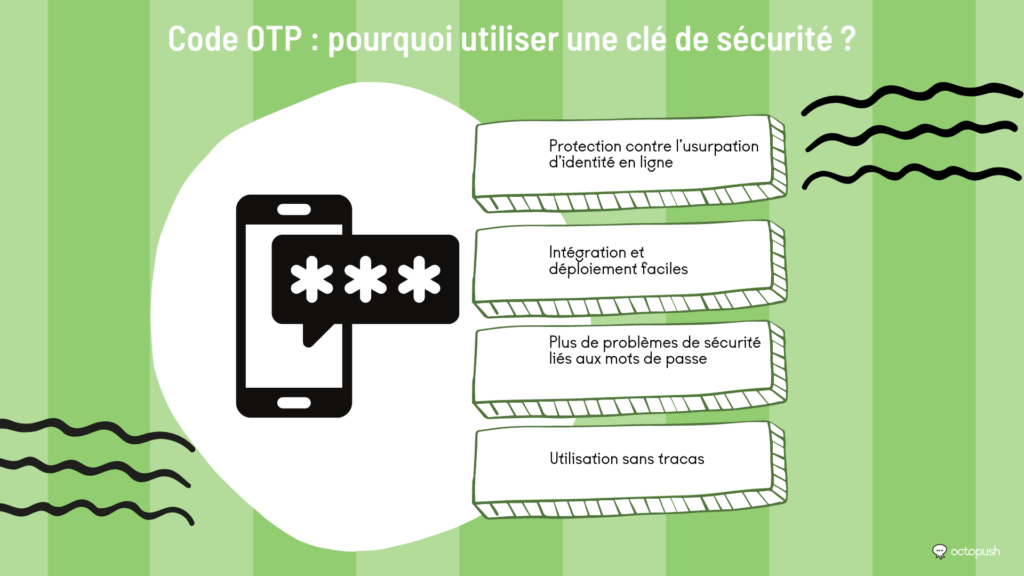
Hassle-free usage
Users prefer fast and seamless authentication: verification SMS are therefore the ideal solution.
Furthermore, Google has recently implemented a Web OTP interface that retrieves the OTP key directly and automatically from the SMS without the recipient having to enter it. This facilitates strong authentication without inconveniencing users.
OTP code: In conclusion
Security breaches in user accounts can lead to the exposure of a large number of user passwords.
To improve the security of the authentication protocol, it is necessary to implement additional authentication using a one-time password. One of the most common solutions for achieving this is using an SMS delivery service.